The National Picture Looks Manageable — Until You Go Deeper
Home Depot generated $127 million in joint compound sales in Q1 2026, down 6% year over year. Lowe's came in at $58 million, down 9%. Home Depot's market share edged up 0.7 points to 68.5%, while Lowe's slipped to 31.5%.
At the national level, the retailer share barely moved. Both lost dollars at roughly similar rates. But the national average hides the fact that the decline is concentrated in one region and, within that region, largely in one state.
The South Is the Culprit
The South declined 12.1%, nearly double the national rate, losing $6.95 million in a single quarter. That one region accounted for 51% of the total category decline. No other region came close — the Northeast fell 8.1% ($3.81 million), and every other region declined less than 6%.
Florida is carrying most of that weight. The state dropped 21.7% in Q1 2026, a $4.76 million swing that represents 68% of the entire Southern decline. The West, by contrast, barely moved — down just 1.0%. A manufacturer applying a national inventory plan to this category would over-correct in stable regions and under-react in the South.
Florida and Kentucky Tell Opposite Retailer Stories
The most actionable signal in the data is not the size of the decline — it is where the two retailers diverge.
In Florida, Home Depot fell 18.4%, from $14.5 million to $11.8 million. Lowe's fell 28.1%, from $7.5 million to $5.4 million. That 9.7-point gap inverts the regional pattern where both retailers decline at roughly the same rate. In Florida specifically, Lowe's lost 1.5 times harder than Home Depot. That is not market softness — it is a merchant-execution signal.
Kentucky tells the flip side. It was the only Southern state to post meaningful growth, up 6.6% in a region that was down 12%. And 100% of that growth came from Lowe's. Lowe's gained $170,000 in Kentucky (up 9.4%) while Home Depot slid 2.4%. When one retailer is growing in a market where everything else is contracting, that is an execution story, not a demand story.
The same retailer — Lowe's — took the biggest hit in Florida and was the only one growing in Kentucky. Same quarter, same region, opposite outcomes. That kind of divergence only becomes visible with state-level, retailer-specific data. Datavations tracks every SKU, every store, every sale across 11,936+ locations daily, giving manufacturers the precision to spot these signals while there is still time to act.
The Brand Shelf Is Locked In
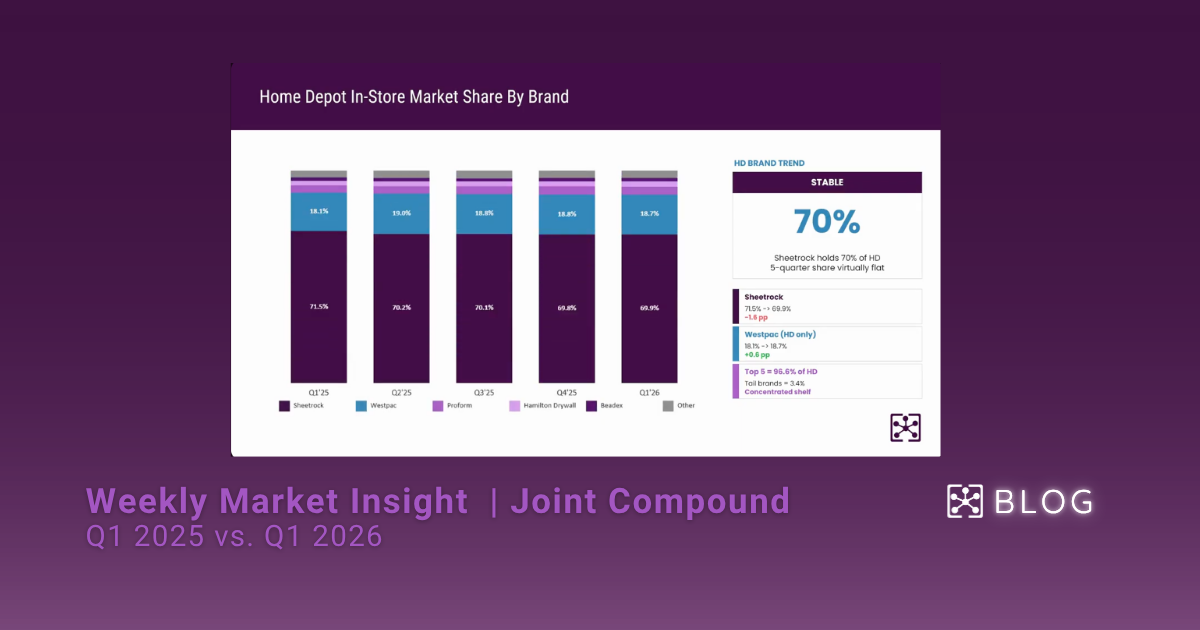
At the brand level, joint compound is one of the most concentrated shelves in building materials. Sheetrock holds approximately 70% of Home Depot, virtually flat over five quarters. Westpac, an HD-exclusive brand, sits at 18.7%. The top five brands account for 96.6% of Home Depot's category — tail brands represent just 3.4%.
Lowe's is even more concentrated. Sheetrock and ProForm together control 91% of the category. ProForm is eight times larger at Lowe's than at Home Depot, making it effectively a Lowe's-lead brand. DAP slipped from 3.3% to 2.8%.
A shelf this locked means the margin opportunity lives in geographic execution, not brand-level shelf gains.
What This Means for Manufacturers
Three patterns from Q1 2026 apply to any concentrated building materials category.
First, national averages are dangerous when regional performance diverges this sharply. A 7% decline sounds uniform. A 12% decline in the South driven by a 22% drop in Florida is a completely different problem requiring a completely different response.
Second, retailer-level divergence within a state is an execution signal. Florida and Kentucky show that the same retailer can be the biggest loser in one state and the only winner in another, in the same quarter. That changes the merchant conversation entirely.
Third, a concentrated shelf does not mean a static one. Even with Sheetrock at 70% and the top five at 96.6%, the regional and state-level dynamics are where share actually moves. The brand that owns the national shelf still needs to manage its position state by state.
How big is the joint compound category at Home Depot and Lowe's?
Joint compound generated $185 million across Home Depot and Lowe's in Q1 2026, down 7% from $199 million in Q1 2025. Home Depot holds 68.5% market share ($127 million) and Lowe's holds 31.5% ($58 million).
Which brand leads joint compound at Home Depot?
Sheetrock dominates with approximately 70% of Home Depot's joint compound sales, a share that has been virtually flat for five consecutive quarters. Westpac holds 18.7% as an HD-exclusive brand.
Why did joint compound sales decline so much in Florida?
Florida dropped 21.7% in Q1 2026, losing $4.76 million and accounting for 68% of the entire Southern region's decline. Lowe's fell 28.1% in the state versus Home Depot's 18.4%, a 9.7-point gap that suggests a merchant-execution issue rather than broad market softness.
What is the joint compound brand mix at Lowe's?
Sheetrock and ProForm together control 91% of Lowe's joint compound category. ProForm is eight times larger at Lowe's than at Home Depot, making it effectively a Lowe's-lead brand.
Watch the full video analysis: View Video


.png)