The ABB and GE Brand Handoff Explained
ABB acquired GE Electrical in 2018. Eight years later, that transition is now fully visible in Home Depot's in-store data. GE revenue collapsed 87% to $0.85 million in Q1 2026. ABB grew 1,102% to $4.38 million over the same period.
On the surface, that looks like a straightforward brand swap. It is not. Combined, the ABB-plus-GE franchise is down 24% year over year, falling from roughly $6.9 million to $5.2 million. That $1.7 million swing accounts for the bulk of the category's total decline. Strip the brand migration out, and the rest of the shelf is relatively stable.
Even with the decline, the combined franchise still leads the Sun Belt, holding between 27% and 49% share across Home Depot's southern regions and peaking at 49% in the Gulf.
Square D Holds the Shelf — But the SKUs Tell a Different Story
Square D, owned by Schneider Electric, held the top position at $15.1 million, essentially flat year over year and still more than half the total category. Flat at the brand level, however, hides real movement underneath.
The Homeline 200A 30-Space Outdoor panel grew 16.2%. The Homeline 200A 40-Space panel with breakers dropped 15.1%. Same brand, same line, opposite directions, same quarter. For a manufacturer or merchant managing this shelf, the brand-level number is misleading. The action is at the SKU level, where consumer preference is shifting toward specific configurations.
This is a pattern Datavations sees across building materials categories — brand-level stability masking SKU-level volatility that only becomes visible with granular, store-level data. Their platform tracks every SKU, every store, every sale across 11,936+ locations daily, capturing the full picture that brand-level reporting misses.
Inventory Health Varies Widely by Brand
In a contracting category, inventory management separates the brands that protect margin from the ones that get squeezed. The breaker box shelf at Home Depot shows a wide spread.
ABB is sitting on 19.2 weeks on hand — the only brand in the excess band. Carrying that much inventory while the category is shrinking is not a buffer. It is a liability that compresses margin and invites markdowns. Eaton and Siemens both sit in the caution band as well, suggesting that the category contraction has not yet fully worked through the supply chain.
For manufacturers selling into a declining category, the conversation with the merchant shifts from how do we grow volume to how do we keep inventory clean and protect per-unit margin. That requires store-level visibility into weeks on hand by SKU, not just a national average.
Out-of-Stocks Are Still Costing Real Revenue
Even as the category contracts, out-of-stocks have cost an estimated $1.77 million in lost revenue over the last five quarters. The problem is not uniform across geographies.
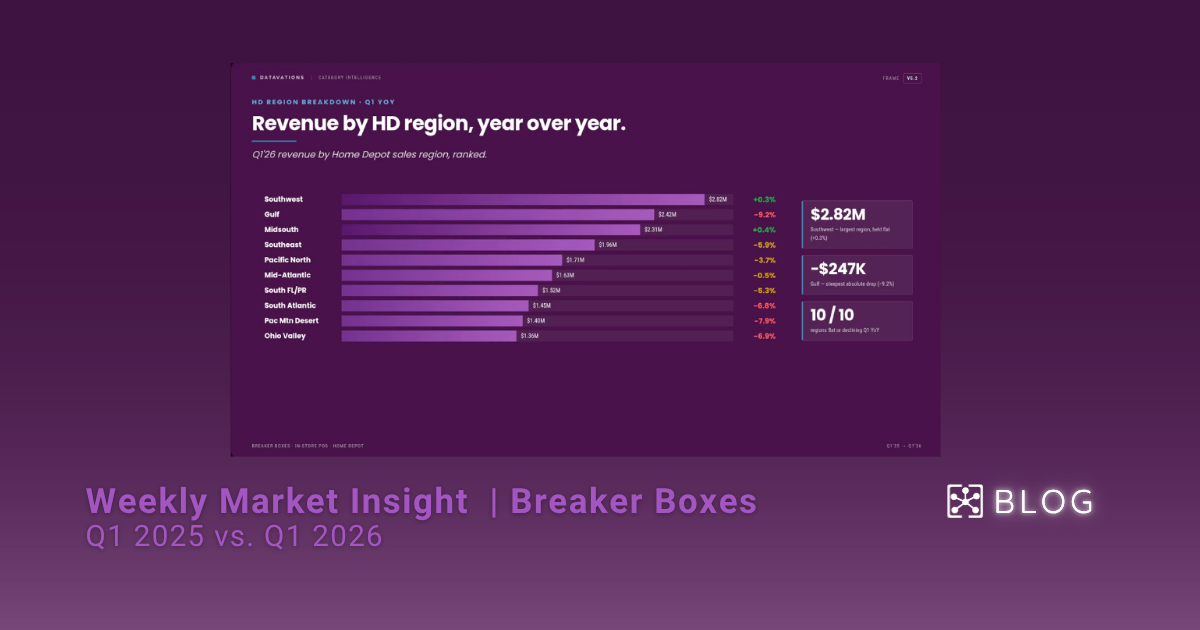
The Southwest — Home Depot's largest breaker box region at $2.82 million — is the one region where out-of-stocks are still getting worse, up 187% year over year. The South, by contrast, improved by 29%. This regional divergence means a national inventory strategy will over-serve some stores and under-serve others. The fix is regional, not categorical.
When most data sources miss 30–35% of building materials volume driven by Pro buyers, these regional gaps compound. Census-level data that captures every transaction at the store level is the only way to isolate where stockouts are concentrated and where excess is building.
What This Means for Manufacturers in This Category
A contracting category sharpens every decision. The brands that protect margin are managing inventory and availability by region, not chasing volume on a declining shelf. Three patterns stand out from the Q1 2026 data.
First, brand-level reporting hides the real story. Square D looks flat, but its SKUs are diverging fast. ABB looks like a rocket, but combined with GE it is down 24%. Manufacturers need SKU-level reads to make accurate decisions.
Second, inventory discipline matters more in a downturn. ABB's 19.2 weeks on hand is excess, not confidence. A clean shelf going into a line review is a stronger position than a loaded one.
Third, regional stockout patterns require regional fixes. The Southwest is getting worse while the South improves. A national replenishment model cannot solve a regional availability problem.
How much did breaker boxes sell at Home Depot in Q1 2026?
Breaker boxes generated $27.9 million at Home Depot in Q1 2026, down 6.6% from Q1 2025. Units declined 16.4% over the same period.
What happened to GE breaker boxes at Home Depot?
ABB acquired GE Electrical in 2018, and the brand transition is now fully reflected in Home Depot's shelf. GE revenue fell 87% to $0.85 million while ABB grew 1,102% to $4.38 million. Combined, the franchise declined 24%.
Which brand leads the breaker box category at Home Depot?
Square D (Schneider Electric) holds the top position at $15.1 million, representing more than half of total category revenue. The brand was essentially flat year over year.
How much revenue have breaker box stockouts cost at Home Depot?
Out-of-stocks in the breaker box category have cost an estimated $1.77 million in lost revenue over the last five quarters. The Southwest region saw the steepest increase, up 187% year over year.
Watch the full video analysis: View Video


.png)