.png)
Lowe's just reported Q2 earnings with a flat comparable store sales number of +0.2%. That headline sounds underwhelming. But dig into the category data and a completely different story emerges.
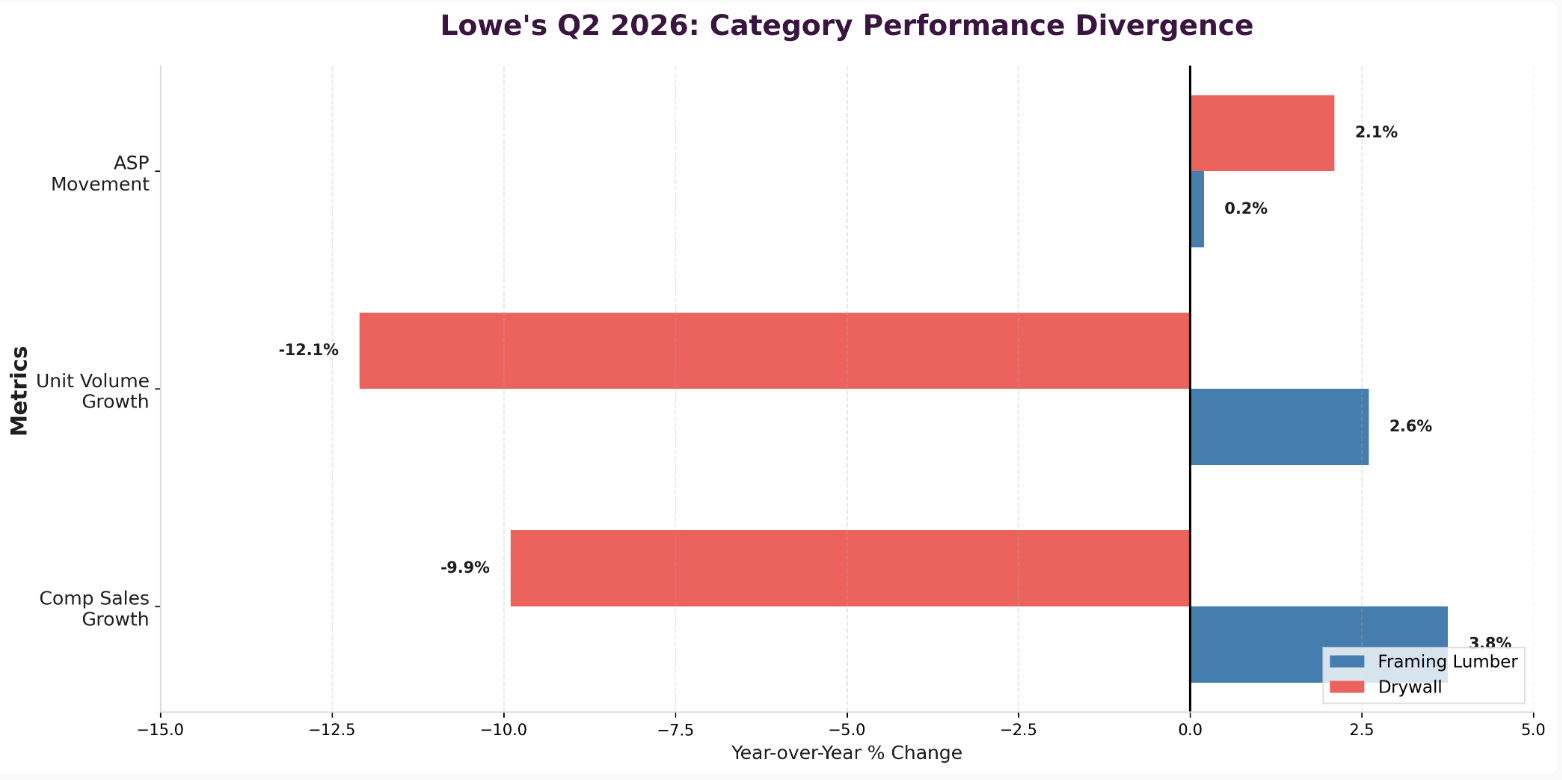
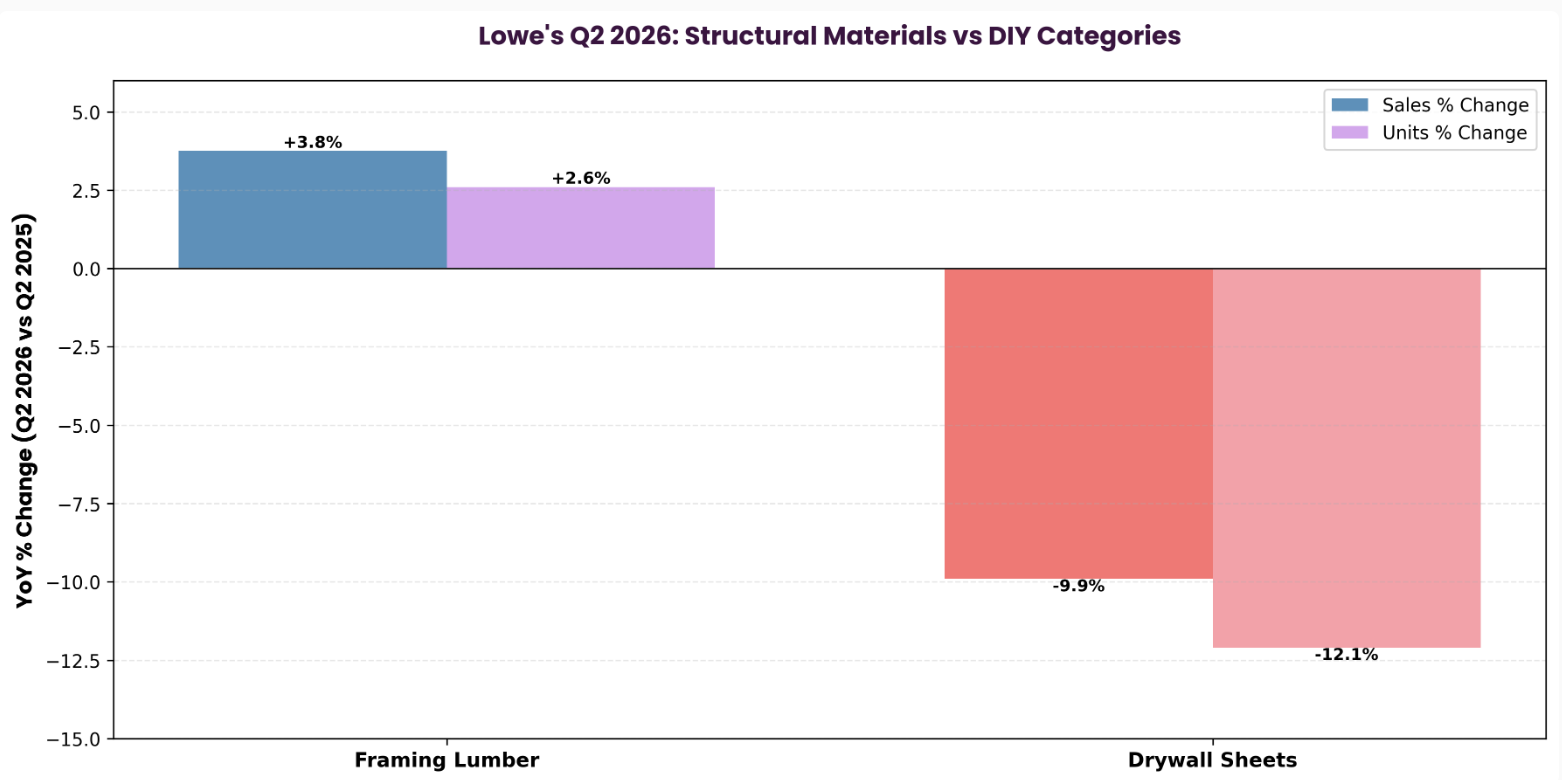
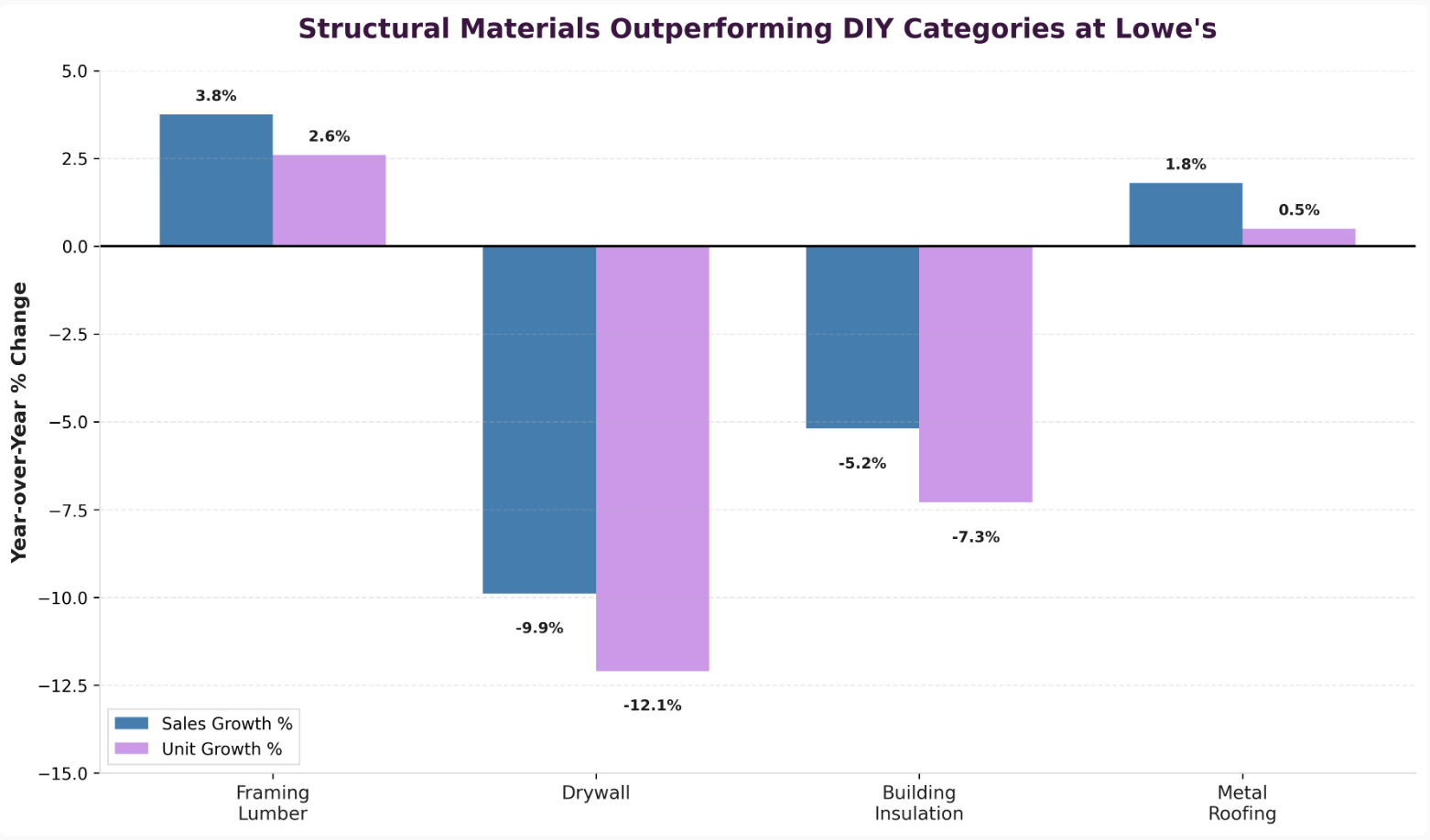
Lowe's is winning decisively in structural materials while the DIY renovation segment collapses. Framing Lumber sales are up 3.75% and units are up 2.6%, while Drywall is down 9.9% in sales and 12.1% in units. That divergence tells you exactly who's shopping at Lowe's right now and what they're buying.
The Divergence: Contractors vs. DIY Customers
The flat +0.2% comp sales number masks a sharp split. Lowe's is capturing contractor and builder spending on essential structural work. At the same time, the retailer is losing DIY customers who would traditionally be buying drywall for interior renovations and finishing projects.
This is not a Lowe's problem. This is a market reality. And it signals where manufacturers need to focus their strategy right now.
Framing Lumber: The Category That's Growing
Framing Lumber is Lowe's bright spot in Q2 2026. Here's what the data shows:
- Sales: Up 3.75% year-over-year (Q2 2026 vs Q2 2025)
- Units: Up 2.6% year-over-year
- Distribution Expansion: +1,394 stores
- Average Selling Price: Stable
That distribution expansion is the key signal. Lowe's isn't just seeing modest growth in framing lumber. The retailer is actively expanding shelf space for this category. That's a capital allocation decision that tells manufacturers exactly what Lowe's believes about contractor demand right now.
Retailers don't add 1,394 store locations for a declining category. They do it because they see sustained demand and they want to capture more of it. For manufacturers selling framing lumber, this is straightforward: Lowe's is investing in your category.
Drywall: The Category in Retreat
Drywall Sheets declined 9.9% in sales and 12.1% in units in Q2 2026. This is not a pricing issue or a promotional pullback. This is volume loss. Customers are buying fewer units of drywall at Lowe's, which could signal fewer interior finishing projects, fewer renovations, or contractors sourcing drywall from competitors or distributors while buying framing lumber here.
Volume Loss Detail: Drywall unit sales fell by approximately 1.4 million units between Q2 2025 and Q2 2026. At an average selling price of $18 per unit, this represents roughly $25.1 million in lost sales volume at Lowe's specifically. This could reflect DIY pullback, contractors shifting sourcing, or both.
Drywall is a staple for both renovations and contractor finishing work. When drywall volume falls this sharply at Lowe's, it signals either homeowners are deferring work, or contractors are sourcing drywall elsewhere while still buying structural materials here—or both. This divergence deserves deeper investigation.
What This Means for Manufacturers
If You Supply Framing Lumber or Structural Materials
You're winning at Lowe's right now. The category is growing, distribution is expanding, and contractor demand is steady. The strategy is clear: ensure assortment breadth, manage stock-outs, and maintain supply reliability. Contractors buying framing lumber are deadline-driven, not price-sensitive. Availability and consistency matter more than margin.
Lowe's is signaling confidence in this category. Match that confidence with reliable supply and you'll win share.
If You're in DIY-Focused Categories
Lowe's drywall data is a wake-up call. Q2 2026 shows sharp volume decline at this retailer, which could reflect customer pullback on renovation projects OR contractors sourcing drywall elsewhere—clarity requires Home Depot comparison. This is the moment to:
- Audit your assortment. Are you carrying the right product mix for a cost-conscious customer?
- Revisit promotional strategy. Price and bundle incentives matter more when projects are discretionary.
- Explore adjacent categories where contractor demand is strong. Consider rebalancing your SKU footprint toward structural materials and Pro-focused products.
Is This a Lowe's Story or an Industry Trend?
That's the critical question. Lowe's data shows clear divergence between structural materials and DIY finishing work. But is Home Depot experiencing the same pattern, or does Home Depot have a different competitive position in framing lumber?
If Home Depot's framing lumber is also growing at similar rates with similar distribution strategies, manufacturers can confidently invest in structural materials and Pro positioning across all big-box retail. If Home Depot's numbers diverge significantly, it signals that one retailer has found a competitive advantage. That means manufacturers need to tailor their approach by retailer.
Our upcoming side-by-side analysis of Home Depot and Lowe's framing lumber performance will answer this definitively. That clarity matters to your strategy.
FAQ: Questions Lowe's Q2 Data Raises
Why is Lowe's comp sales flat if framing lumber is growing?
Framing lumber is a win, but it's concentrated. The category represents a portion of Lowe's mix, so growth there is offset by weakness in larger DIY categories. The flat +0.2% comp sales reflects a portfolio under mixed pressure.
Should DIY manufacturers panic about the drywall decline?
Not necessarily. A sharp Q2 decline doesn't automatically mean the category is doomed. The question is whether this is cyclical (temporary pullback) or structural (long-term shift in consumer behavior). Lowe's Q3 performance and forward guidance will clarify.
What does distribution expansion signal?
When a retailer expands shelf space in a category, it's a bullish signal. Lowe's is betting that framing lumber demand will remain strong enough to justify more inventory in more stores. For manufacturers, this is a buy signal from the retailer.
How does this compare to Home Depot?
Home Depot's Q2 framing lumber performance is the key comparison. If Home Depot shows similar growth rates and distribution strategies, it's a market trend. If Home Depot's numbers diverge significantly, one retailer is winning the contractor wallet on this category.
Ready to understand how Lowe's and Home Depot are competing for the same contractor and DIY wallet in Q2 2026? We're building a cross-retailer category comparison that shows which retailer is winning where, and what that means for your competitive position.
Contact us for a deeper analysis of your category performance across Lowe's and Home Depot.
Sources: Lowe's Q2 FY2026 Earnings Release (August 2026). Category-level performance data from Datavations Bolt Census Data. Volume loss calculations based on verified unit and ASP data. All comparisons are year-over-year (May–July 2026 vs May–July 2025).
.png)